
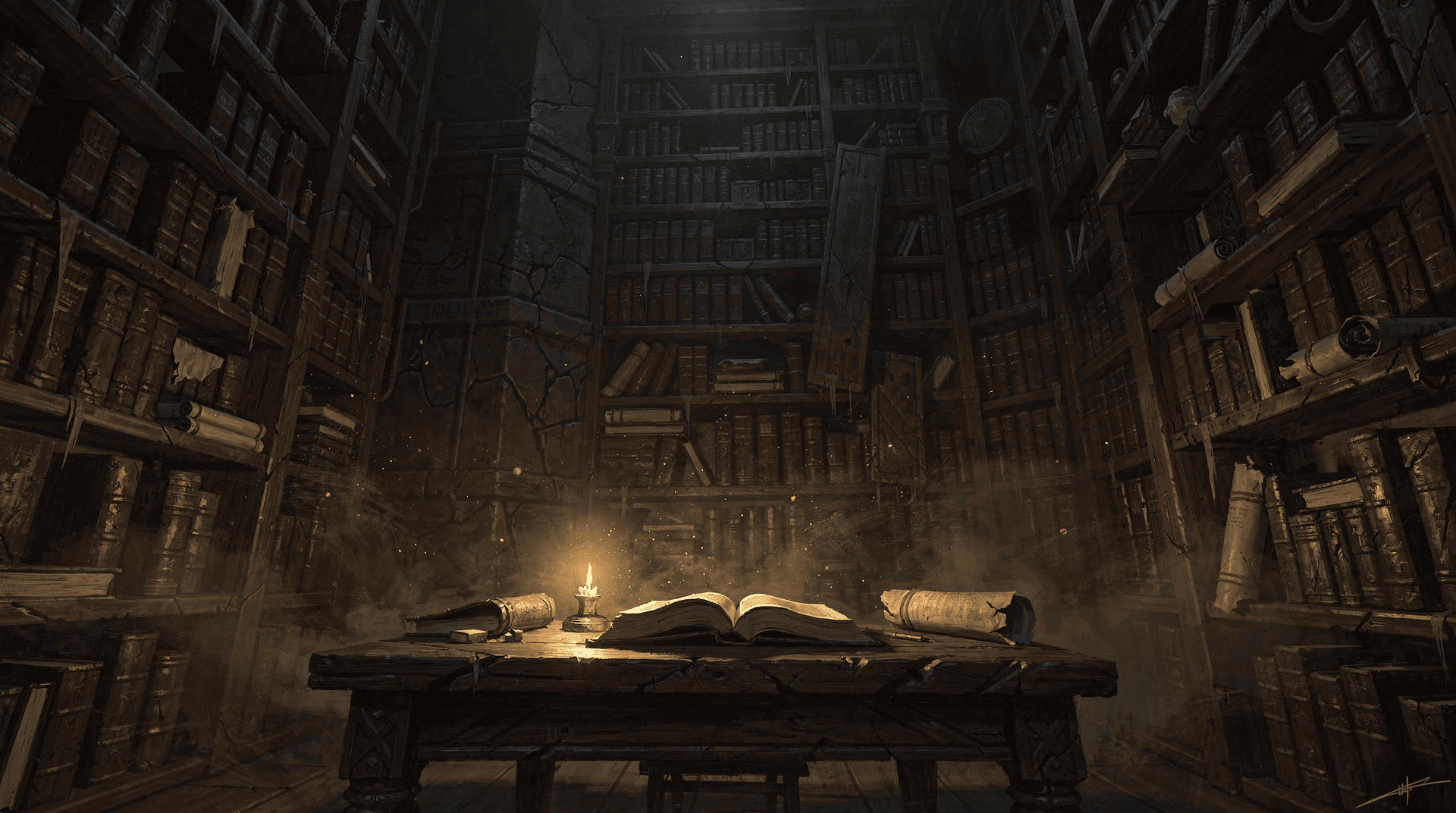

Why Does AI Dungeon Forget Your Story? Memory Loss in AI RPGs, Explained
You name an NPC, give them a voice, build a rivalry over a dozen turns — and twenty rounds later the AI calls them by the wrong name, or forgets they exist. It is the single most common complaint about AI dungeon masters, and it is not a bug you can prompt your way out of. It is how the underlying memory works. Here is what is actually happening, and what a platform has to do differently to stop it.
Why does AI Dungeon forget your story?
AI Dungeon forgets because it reads your story through a context window — the fixed amount of recent text a language model can hold in mind at once. Everything the AI “knows” on a given turn is whatever fits inside that window. Past its edge, content has to be either dropped or compressed into a shorter summary.
Platforms compress rather than drop, because dropping is worse — an AI that has never heard of the king will invent a new one. But compression is lossy by design. The summariser keeps what looks structurally important (major plot beats, the last few decisions) and sands off the rest. The first things to go are the texture: an NPC's personality, the exact way a relic was described, a minor name, the off-hand remark in chapter two that turns out to be the whole mystery.
If you have played long enough to notice it, you know the feeling: the world is vivid at the start, then quietly grows shallower. Characters lose their voices, places lose their details, and the campaign drifts. That is memory drift, and it is structural — the same failure shows up across AI Dungeon, generic ChatGPT or Grok dungeon masters, and any tool that leans on the window alone.
What is the difference between a context window and campaign memory?
A context window is short-term working memory. It is rebuilt every turn from the recent transcript, it is fast, and it is finite — and when the campaign outgrows it, the window's contents get compressed, which is where detail dies.
Campaign memory — sometimes called platform-level or persistent memory — is a separate, structured store that lives outside the chat. Instead of one long transcript, it keeps a record per entity: an entry for each NPC, location, thread and established fact, updated when something material happens and re-injected as canonical context on later turns. The window handles the last few turns of conversation; campaign memory handles the whole campaign.
They are two different systems doing two different jobs. The window is good at flow and immediacy. Campaign memory is good at consistency over time. A platform that only has the first will always drift; a platform that has both can keep your blacksmith a blacksmith in round 40.
Does a bigger context window fix AI memory loss?
No — a bigger window delays the problem instead of solving it. Every context window is still finite, so a long enough campaign always reaches the edge. And the “just make it bigger” approach has two real costs: stuffing hundreds of rounds of raw transcript into every single turn is expensive and slow, and models reliably lose accuracy on information buried in the middle of very long contexts — a well-documented effect researchers call “lost in the middle.”
The structural fix is not a bigger buffer; it is retrieval from a curated memory store. Keep the canonical facts in a compact, structured form, and pull the relevant ones into the window on demand. Encyclopedia first, transcript second. That keeps each turn cheap and focused while the campaign as a whole stays consistent.
Can you fix AI Dungeon memory loss with better prompting?
Partly — and only with constant effort. Pinning key facts, writing an Author's Note, and hand-editing the memory box all help nudge what survives compression. Experienced players get real mileage out of them. But they are manual maintenance you redo as the campaign grows, they still compete for the same finite window, and they put the bookkeeping on you instead of the platform.
It is a workaround for a structural limitation, not a cure. The better question is not “how do I prompt around the forgetting?” but “why is the forgetting my job to manage at all?” The right place to solve memory drift is the platform — it should maintain the campaign's memory the way a human DM keeps session notes, without asking you to babysit a text box.
What does platform-level campaign memory do differently?
Platform-level campaign memory treats your campaign's facts as a first-class system, separate from the chat log: a structured store the AI retrieves from every turn instead of re-deriving everything from a compressed transcript. In practice that means two layers working together — a recurring key-facts buffer that keeps the load-bearing details in front of the AI on every turn, and a structured wiki that records each NPC, place and thread as a canonical entry. Consistency holds across dozens of rounds, not just the last few.
That is how LoreKeeper handles it. The key-facts buffer runs on every tier; on Hero and Legend, a living wiki writes a structured encyclopedia of your campaign as you play and re-injects it as canonical context. In our own forty-round end-to-end test, that layer captured 63 canonical entries — 18 named NPCs, 14 locations, 9 quests and 5 threads — and the NPC introduced in round 30 was still the same character, carrying the same items, in round 40.
Memory is also why a structured rules engine matters. When hit points, conditions and the state of a fight live in durable game state instead of being re-derived from the transcript, the AI cannot “forget” that an enemy is already dead or that your character is poisoned. Consistency in the story and consistency in the mechanics come from the same idea: keep the truth outside the chat window.
If you are leaving a freeform tool specifically because the memory breaks on long campaigns, that is the feature to evaluate first. For a side-by-side, see LoreKeeper vs AI Dungeon.
Frequently Asked Questions
Why does AI Dungeon forget my character and story?
Because it relies on the model context window — the limited slice of recent text the AI can read at once. Once a session grows past that window, older turns are summarised or dropped, and the lossy summary discards exactly the details that make a campaign feel real: NPC personalities, item descriptions, minor names, off-hand clues. The AI is not broken; it literally no longer has the information in front of it.
What is the difference between a context window and campaign memory?
A context window is short-term working memory rebuilt every turn from the recent transcript — fast but finite and lossy when compressed. Campaign memory (also called platform-level or persistent memory) is a separate, structured store that lives outside the chat: a record per NPC, location, thread and fact, updated when something material happens and re-injected as canonical context. The window handles the last few turns; campaign memory handles the whole campaign.
Does a bigger context window fix memory drift?
Not really. A larger window delays the problem at higher cost, but every window is still finite, and stuffing hundreds of rounds of raw transcript into each turn is expensive and slow — and models still lose the thread inside very long contexts ("lost in the middle"). The structural fix is retrieval from a curated memory store, not a bigger buffer. Encyclopedia first, transcript second.
Which AI RPG platforms keep memory across long campaigns?
Platforms built around a structured rules engine and persistent campaign state hold up better than freeform-only tools. LoreKeeper keeps a recurring key-facts buffer on every tier, and on Hero and Legend it maintains a living wiki — an auto-written encyclopedia of your campaign that is re-injected as canonical context so NPCs and threads stay consistent across dozens of rounds.
Can I fix AI Dungeon memory loss with better prompting?
Partly, and only with constant effort. Pinning key facts, maintaining an Author's Note and editing the memory box help, but they are manual work you redo as the campaign grows, and they still compete for the same finite window. It is a workaround for a structural limitation, not a fix. A platform that maintains the memory for you removes the chore.
Play a Campaign That Actually Remembers It
LoreKeeper keeps your NPCs, places and plot consistent across long campaigns with platform-level memory — not a context window you have to babysit. Living wiki on Hero (€9.99/mo) and Legend (€19.99/mo).
Free trial available. No credit card required.
Related guides
Does an AI Dungeon Master Railroad You?
Why AI dungeon masters railroad, what fail-forward does instead, and how persistent memory lets your choices stick.
What Is an AI Dungeon Master?
Definition, how it differs from ChatGPT, when to use it, and what to expect at the table.
How to Play Solo D&D with AI
Step-by-step guide covering setup, character creation, and tips for better solo sessions.