

How LoreKeeper's AI DM Remembers Your Campaign Across Hundreds of Rounds
After thirty rounds with an AI Dungeon Master, how many of the NPCs you met still exist for it? The honest answer, on most platforms, is: very few. The chat scrollback gets summarised, the summaries lose detail, and your party's favourite blacksmith quietly stops being a blacksmith. LoreKeeper does something different. This is a walk through the living wiki and why long campaigns feel grounded instead of forgetful.
Why do AI Dungeon Masters forget your campaign after a while?
Every large language model has a context window — the slice of recent conversation it can read at once. Past the edge of that window, content has to be either dropped or compressed. AI DM platforms compress, because dropping is worse: a model that has never heard of the king is going to make up a king from scratch.
Compression is lossy by nature. The summariser keeps what looks structurally important — major plot beats, recent decisions — and sands off everything else. NPC personalities are usually the first thing to go. So is the specific way an item was described. So is the off-handed remark a stranger made in chapter two that turns out, twenty rounds later, to be the entire mystery.
This is a known failure mode. If you have ever played long enough with an AI DM to notice it, you know exactly what it feels like: the world is alive at the start, then quietly grows shallower as sessions go on. Characters lose their voices. Places lose their details. The campaign drifts.
The fix is not a bigger context window — that just delays the problem at higher cost. The fix is to have a separate, structured memory that the DM can pull from on demand: encyclopedia first, transcript second.
What is the Living Wiki in an AI DM platform?
The living wiki is a structured memory system that runs alongside your campaign. Every named NPC, place, thread and significant piece of lore gets its own article. Articles are written, updated and validated by a four-stage pipeline that runs in the background whenever something material happens at the table.
The four stages, briefly:
- Planner. Reads the round and decides what is worth recording — a new NPC just appeared, an existing thread advanced, a piece of lore was revealed. If nothing material happened, no work runs.
- Narrative scout. Pulls in the surrounding context the writer needs: prior articles that link to this one, the relevant chunk of recent narrative, and any contradictions to flag.
- Generator. Writes the article — a structured Markdown document with named sections, a one-line summary, and explicit cross-links to related entries.
- Validator. Final pass. Checks the schema is valid, flags unverified claims as TODO-VERIFY blockquotes (so the writer doesn't silently invent), and updates freshness metadata so future rounds know when the article was last touched.
The output gets stored as durable content — not session memory. When the DM is composing the next round, it doesn't have to re-derive who Brother Vesran is from a compressed transcript; it reads his article. That alone is the entire trick.
What is the player-facing Codex and how does it work?
Without a UI, the living wiki is invisible. So we built one. Inside every campaign there is a Codex tab — read-only, in-character, and curated. Click it and you get an encyclopedia of the campaign, organised into Characters, Locations, Quests, Threads and Lore. Each entry shows a one-line summary and a last-updated timestamp.
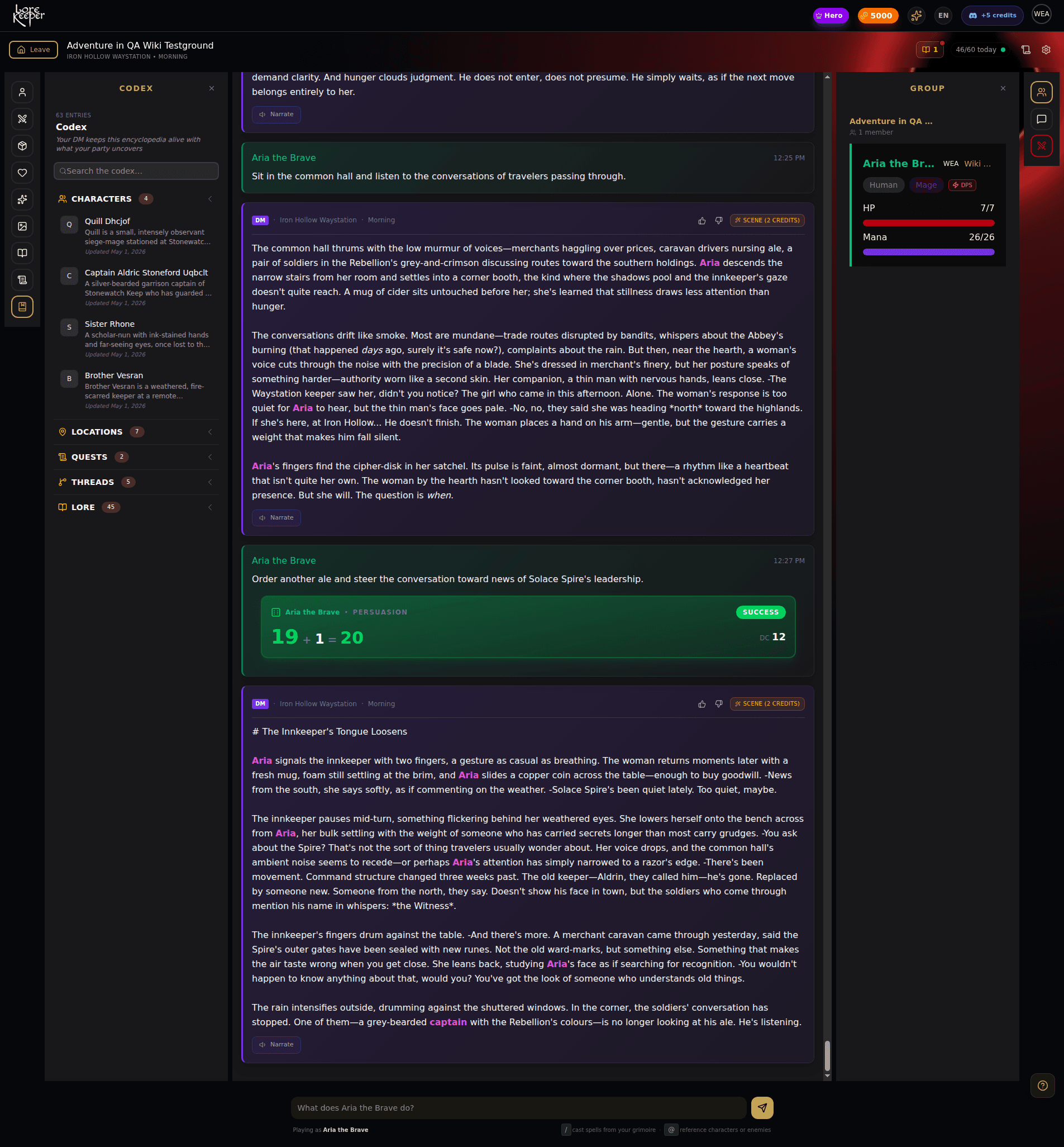
Click any entry and you get the full article: the one-line summary up top, then the prose, then a footer of backlinks to every other article that references this one. Inline mentions inside the prose are clickable too — say the Codex of Iolen comes up in Brother Vesran's article, click it, and the modal swaps to the Codex of Iolen's entry without closing.
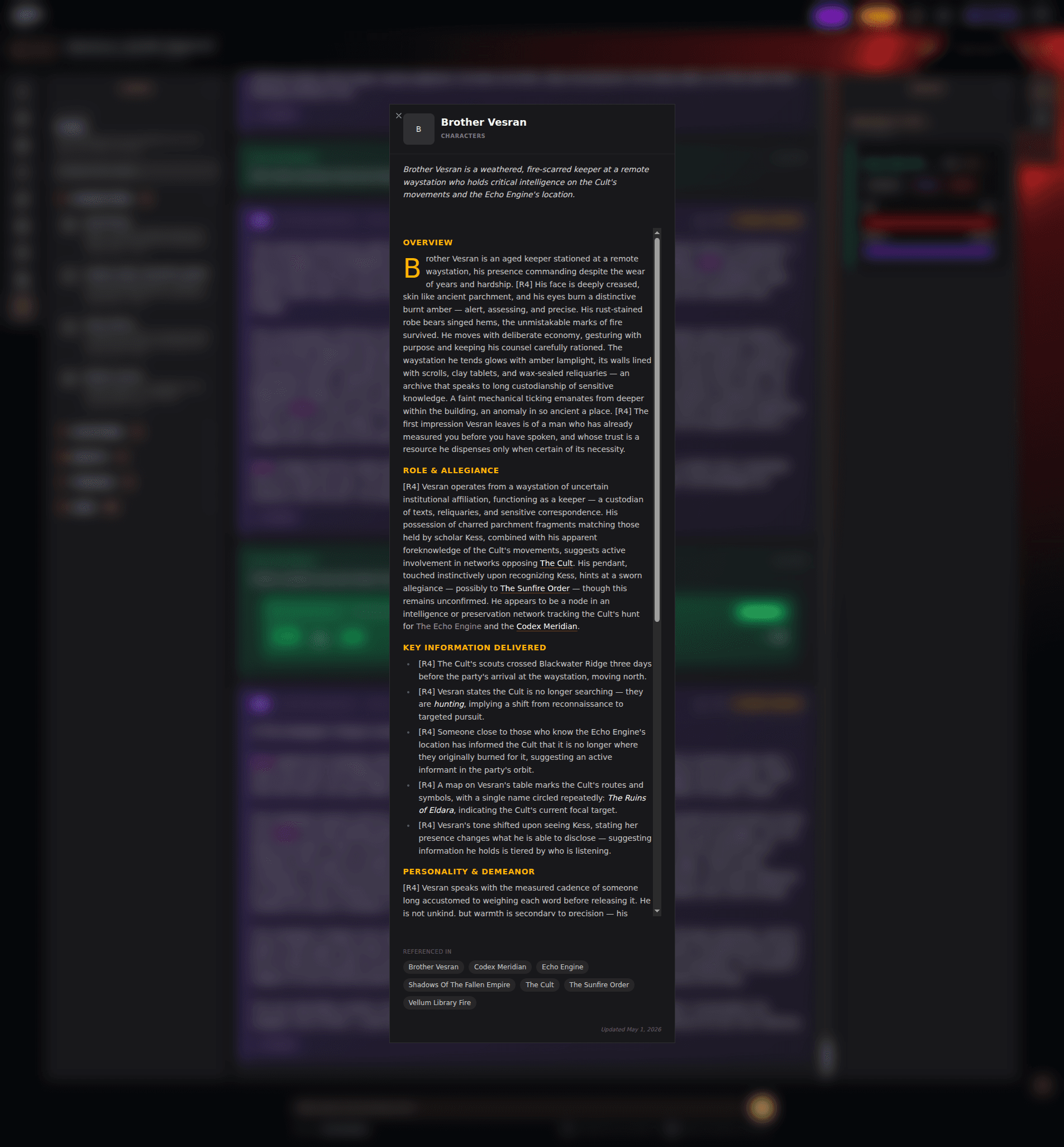
What players don't see is just as important as what they do see. DM-only sections — flagged in the article body and meant for the AI's eyes only — are filtered out before any content leaves the server. Same for the validator's TODO-VERIFY notes; those are workshop scaffolding, not canon. What reaches the Codex is the part of the campaign your characters could plausibly know.
The Codex doesn't replace narrative. It complements it. When you come back from a two-week pause and forget who you were arguing with, you check the Codex, refresh, and step back into the story.
What does a real 40-round campaign look like with a Living Wiki?
Some context for what this looks like in practice. Our internal end-to-end test runs a forty-round campaign in a custom world. By round forty, the living wiki has captured 63 articles — eighteen named NPCs, fourteen locations, nine quests, five threads, and a tail of lore.
Brother Vesran was introduced in round 30. He's a survivor of the burned scriptorium of Iolen, carrying the cipher-disk that belonged to his order. Ten rounds later, in round 40, he's still that person. Same evasive eye contact, same ferrogallic ink stains on his fingers, same limp in his right foot from the night of the fire. He has not become a generic monk. He has not forgotten what he was carrying. The narrative around him has evolved — he has met more of the party, his story has been tested against new evidence — but the core of who he is has held.
Multiply that by every named character in the campaign and you start to see why long sessions feel different here. There is no moment where the DM quietly forgets that the innkeeper's name was Marlene and starts calling her something else. The world stays where you put it.
The same applies to threads. The Cult's pursuit of the Echo Engine, introduced in round three, is still recognisable in round forty. Players can follow it in the Codex — open the “Echo Engine” entry, see which articles reference it, trace the timeline backwards. The wiki is, among other things, a tool for players to remember their own campaign.
Where can you use the Living Wiki and how much does it cost?
The living wiki is part of the Hero and Legend plans. The €2 difference between Adventurer (€7.99/mo) and Hero (€9.99/mo) is what unlocks it. There is no per-round surcharge, no extra credit cost, and no per-article fee. The compile work runs inside your existing plan.
Eligibility is decided by the campaign host. If you create a campaign on Hero, every player at the table sees the Codex — including guests on the free tier. The host pays; the table benefits. This matches how a real DM works: the person who prepared the world is the one whose plan determines its features.
If you have a long campaign that has started to feel forgetful, or a multi-session arc that you want to come back to in a few weeks, this is what you upgrade for. The chat-history-only tiers are fine for one-shots and short arcs; the living wiki earns its place around session three.
Frequently Asked Questions
Does the AI DM remember NPCs from earlier sessions?
Yes — the living wiki captures every named NPC the party meets and feeds that knowledge back into the DM context on every turn. Round 30 still knows what Brother Vesran was carrying when you met him in round 15. This is independent of the chat scrollback, which gets summarised and truncated as sessions grow.
How is the living wiki different from chat history?
Chat history is the raw transcript. As campaigns grow long, models compress old turns into shorter summaries — useful for pacing, but lossy. Personality details, item descriptions and minor NPC names are exactly what gets cut first. The living wiki is curated structured memory: a separate article per NPC, place, thread or piece of lore, updated when something material happens, validated, and re-injected as canonical context. Two different memory systems doing two different jobs.
Can I see the wiki my DM is writing?
Yes. There is a Codex tab inside every campaign for plans that include the feature. Players can browse all named NPCs, locations, threads and lore, click on any entry to read its full article, and follow inline links to related entries — without ever leaving the play screen. The Codex is read-only: only the AI DM writes it. DM-only secrets and unverified notes are filtered out before any content reaches the player.
Which plans include the living wiki?
Hero (€9.99/mo) and Legend (€19.99/mo). Free and Adventurer campaigns run on the standard memory model — chat history with summarisation, plus the recurring key-facts buffer. Once the campaign owner is on Hero or Legend, every member of the party can read the Codex regardless of their own tier. Memory is created by the host; the table benefits.
How much extra does the living wiki cost in credits?
Zero extra. The compile work runs as part of the regular round flow when there is something material to record. Cost on our end measures around $0.029 per round and $0.041 per article — already absorbed into the plan price. Cache hits keep the marginal cost low even on busy campaigns; a typical Hero campaign sees a 50% steady-state cache rate after the first few sessions.
Run a Campaign That Remembers Itself
LoreKeeper's living wiki keeps your NPCs, places and threads consistent across dozens of rounds. Available on Hero (€9.99/mo) and Legend (€19.99/mo). Every player at the table reads the Codex.
Free trial available. No credit card required.
Related guides
AI DM Wiki Tools Compared: LoreKeeper Codex vs Self-Hosted LLM Wikis
Self-hosted LLM wiki scripts vs auto-compile inside the play loop — workflow, latency, privacy and cost compared.
AI Dungeon Master Multiplayer
Real-time multiplayer with an AI Game Master — how groups join and play together.
Party Mode: RPG with Friends on One Device
Turn any TV or laptop into a full tabletop RPG night — AI narration, voice input, scene images.